

Nature Villa Stay in Costa Rica, Done Right
- February 27, 2026
- Blog
Plan a nature villa stay Costa Rica travellers love: where to base near Santa Teresa, what to pack, and how to balance... Read More
The first sound that pulls you out of sleep in Santa Teresa is rarely an alarm. It’s more likely a rising chorus from the treeline – a few clear whistles, a rougher croak, then a sudden burst of wingbeats as the forest shifts into morning.
That’s the quiet gift of this part of the Nicoya Peninsula. You can come for surf and sunsets and still end up building your day around birds – because here, the wildlife doesn’t live “somewhere else.” It’s close, and if you slow down just a little, it becomes part of your routine.
Bird watching Santa Teresa Costa Rica feels different from birding in a big national park with gates and opening hours. The landscape here is a patchwork: coastal scrub, fruiting trees in gardens, pockets of secondary forest, riparian corridors near Río Negro, and then deeper, greener hills as you head inland.
That mix creates variety. You’re not limited to one habitat, and you don’t need to do a long transfer to start seeing life. Trade-off: because it’s not a single protected reserve, sightings can be more “it depends.” Weather, recent rain, and even which trees are fruiting this week can change what you see.
If you enjoy birding that feels a bit like tracking, listening, and learning a place, Santa Teresa is rewarding.
Early morning is the easy answer, and it’s true. From first light to about 8:30 a.m., birds feed actively and call more. Late afternoon can also be excellent, especially along edges where forest meets open space.
Midday isn’t useless, but it’s slower. In the heat, many species go quiet and tuck into shade. If you only have midday, aim for water or denser forest where it stays cooler.
Season matters, too. During the dry season (roughly December to April), you’ll often get clearer mornings and easier trails. In the green season (roughly May to November), the forest feels alive and lush, and breeding activity can be high. The trade-off is rain – sometimes a short shower, sometimes a real downpour that changes your plan.
Migratory timing can add a bonus layer, especially in the months when North American migrants are present. You won’t need to “chase” them; you’ll notice more variety in mixed flocks and along edges.
You don’t need a long checklist of hotspots to enjoy birding here. A few well-chosen environments will give you a strong chance at variety, and you can build them into a normal day.
Head toward Río Negro and you’ll find exactly what many birds love: water nearby, taller trees, and quieter roads than the beach strip. The edges – where vegetation meets open areas – can be productive because birds move through for fruit, insects, and cover.
If you’re staying inland, this is the kind of place where you can do a short walk with a coffee and be “in it” within minutes. It’s also friendlier for listening. Less traffic noise makes it easier to locate calls, which is half the game.
Montezuma sits in a slightly different pocket of the peninsula, and that change in feel often comes with a change in species. If you’re planning a day trip anyway, bring binoculars and treat the drive and stops as part of the birding.
You’ll often notice more dense forest and humid pockets, especially near water. It can be a good place to look for species that prefer deeper cover, plus plenty of common birds that are simply easier to observe when there’s less open sun.
For many guests, Manzanillo is a reset button. It’s calmer, and that calm helps you spot movement along the treeline and coastal vegetation. Shore-adjacent birds, raptors riding thermals, and the ever-present “something rustling in the branches” all show up more clearly when you’re not dodging crowds.
This sounds too simple, but it’s often the best birding you’ll do. If you spend 20 quiet minutes with your coffee – no phone, no music – you’ll start noticing patterns. Birds take the same routes. They return to the same fruiting trees. Some species show up reliably at the same time each day.
A nature-immersed stay makes this easy. If you’re looking for a peaceful base surrounded by wildlife while still being close to Santa Teresa and day trips, you can see our villas at https://villaspuravida.com/.
Birding here is full of happy surprises, but it’s still wildlife – no one can promise specific sightings. What you can expect is a strong mix of colourful “headline” birds and smaller species that become favourites once you learn to spot them.
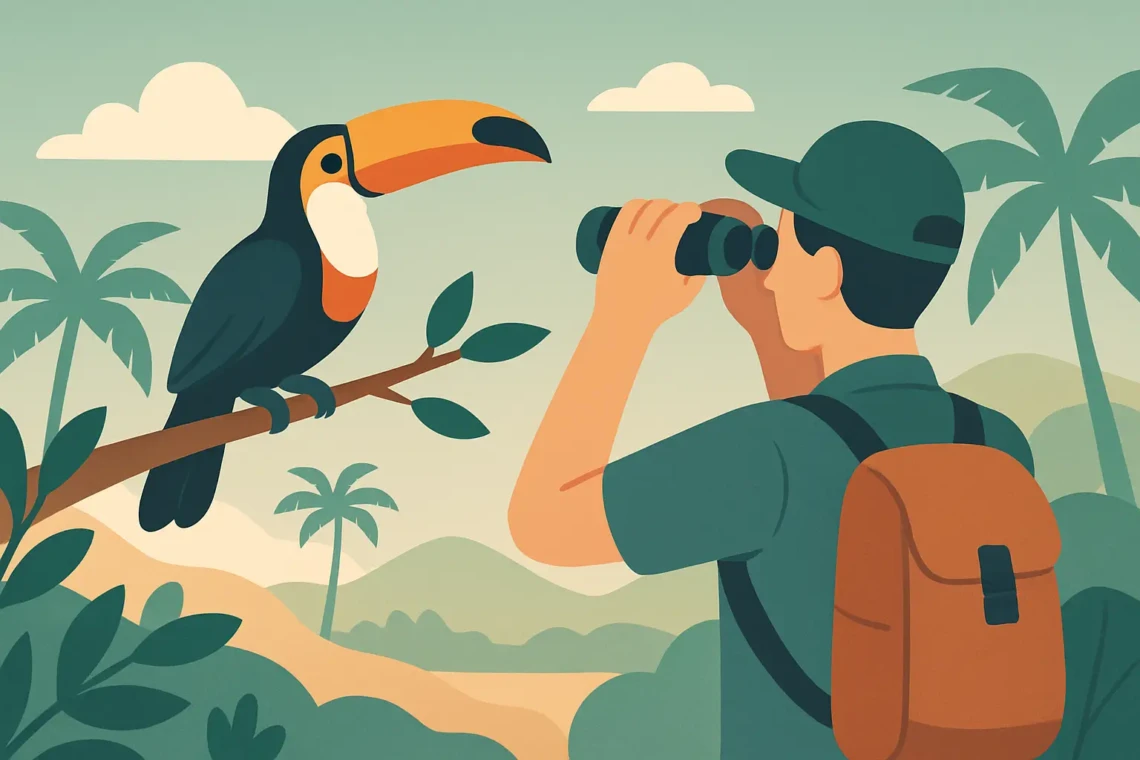
You may see parrots and parakeets moving in noisy groups overhead, especially early and late. Toucans are a classic wish-list bird in this region, often spotted in fruiting trees or heard before you see them. Hummingbirds can appear like quick sparks around flowering plants, and raptors are common above open areas when the day warms.
Then there are the birds that make Costa Rica feel like Costa Rica: the ones with bold calls, unusual silhouettes, or habits that make you stop walking. The best approach is to treat every outing as a “what’s here today?” walk, not a checklist sprint.
You don’t need a full kit to enjoy bird watching. A decent pair of binoculars makes a big difference, and comfort matters more than people expect.
Lightweight long sleeves can help with sun and insects. Closed-toe shoes are worth it if you’re walking near brush or uneven ground. A small daypack for water is enough.
For identification, a bird app can be helpful, especially if it includes calls. Just keep volume low if you play audio – better yet, use it privately with headphones. The goal is to observe without turning the forest into your soundtrack.
The easiest way to “see more” is to slow down. Walk a short stretch and stop. Listen for two full minutes. Look for movement, not colours.
Birds often reveal themselves in layers. First you hear them, then you notice leaves flicking, then you see the shape. If you’re new to birding, focus on three things: calls, flight paths (where they cross openings), and fruiting or flowering trees.
Mixed flocks are common in the tropics. If you find one active group moving through, stay with it gently. You might pick up several species in one spot as they feed together.
Santa Teresa is a community, not a theme park. Birding is most enjoyable when it stays quiet and considerate.
Keep a respectful distance from nests and don’t push into dense brush to get a photo. If you’re on a roadside, be mindful of traffic and private property. If you’re walking near someone’s home or a small business, a simple “buenos días” goes a long way.
It’s also worth being careful with playback (playing bird calls to attract birds). It can stress wildlife, especially during breeding seasons. If you’re travelling with kids, turn it into a listening game instead – it’s more fun, and the birds keep doing what they were doing.
If your trip is surf-forward, do birds in the “in-between” hours. Go out at first light for a 30-minute walk, then have breakfast and hit the beach. You’ll feel like you did something extra without losing the day.
If you’re working remotely, treat birding as a reset between meetings. A short loop at 4:30 p.m. can be surprisingly active, and it’s a gentle way to transition out of screen mode.
And if you’re here for longer stays, repeat the same route a few times. You’ll start recognizing individuals and patterns, which is when bird watching stops being an activity and starts feeling like you live here.
Self-guided birding is great if you enjoy wandering and discovery. A local guide becomes worth it if you’re short on time, you want help with identification by call, or you’re hoping to see specific groups like raptors or forest species.
The trade-off is pace. Guided outings can be more focused and slower, because stopping to listen and scan is the whole point. If your travel style is go-go-go, choose a shorter tour and keep the rest of the day flexible.
If you do hire a guide, tell them your comfort level (easy walks vs. longer hikes), what time you like to start, and whether you’re more interested in a big list or a relaxed learning experience.
If you only do one thing for bird watching in Santa Teresa, make it this: step outside a little earlier than you planned, stand still, and let the first ten minutes happen without trying to “get” anything. The birds will tell you where the day is going – you just have to give them a quiet moment to start.

Planning bird watching santa teresa costa... Read More

Plan a nature villa stay Costa... Read More

Find a quiet villa Santa Teresa... Read More

Con mucho gusto.
Hola Maricela, muchas gracias por tu lindo comentario. Para nosotros fue un gusto haberlos…
Lugar súper recomendado para hospedaje, quedamos fascinados de tan hermosas villas, (bellísimos acabados),donde se…
Hola Freddy, muchas gracias por tus lindas palabras. Para nosotros fue un gusto hospedarlos…
Un lugar muy bello villas mango súper recomendado los dueños y los encargados son…

Enter your email address and we will send you a link to change your password.
Join The Discussion