



Hotel vs Private Villa Santa Teresa – Which Fits?
- October 27, 2026
- Blog
Hotel vs private villa Santa Teresa: compare privacy, location, amenities and daily rhythm to choose the Costa Rica stay that suits your... Read More
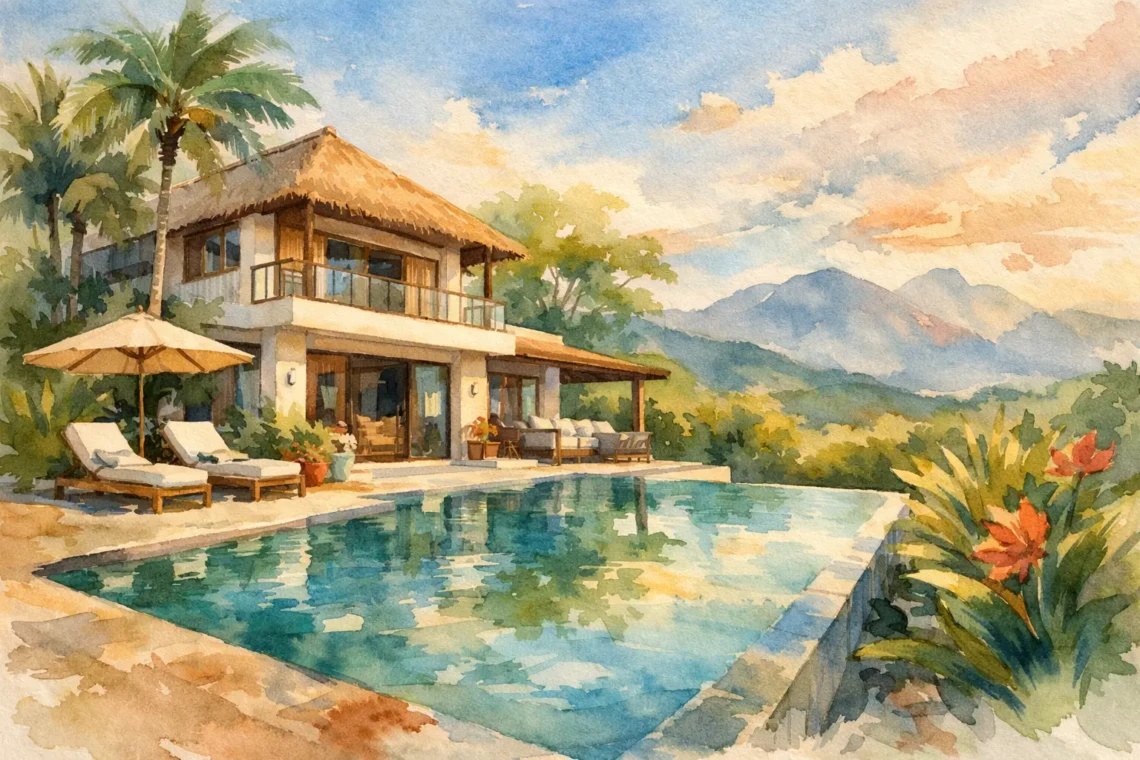
A beautiful villa near Santa Teresa can look like an easy investment from a distance: strong holiday demand, warm weather year-round, and guests who will pay for privacy, a pool, air conditioning, and reliable Wi-Fi. But a rental yield example in Costa Rica only becomes useful when it includes the quieter parts of ownership too – seasonality, cleaning, maintenance, local management, and the weeks when the calendar is not full.
For buyers considering a home that can also welcome guests, the goal is not to chase one impressive percentage. It is to understand what a property may earn under realistic conditions, what it costs to operate well, and whether the result supports the lifestyle and investment plan you have in mind.
Let’s use a hypothetical two-bedroom villa in the Santa Teresa area. It is modern, fully equipped, surrounded by nature, and within easy driving distance of beaches, cafés, and everyday services in Cóbano. The purchase price is US$450,000, including furnishings, basic setup, and closing-related costs for the sake of a simple example.
The villa is offered as an entire-place holiday rental. Its average nightly rate changes through the year: higher during Christmas, New Year’s, Easter, and the dry-season travel period; lower during the green season and quieter weeks. Rather than using the peak-season rate in every calculation, we will use an average achieved nightly rate of US$275.
If the villa books 180 nights over a year, that is roughly 49% occupancy. The gross rental income is:
180 booked nights x US$275 = US$49,500 gross annual revenue
Gross yield is annual gross revenue divided by the total investment:
US$49,500 / US$450,000 x 100 = 11% gross rental yield
At first glance, 11% may look very attractive. Yet gross yield does not tell you what stays in your pocket. A villa that feels effortless to a guest takes ongoing work behind the scenes.
Operating costs depend on the property, rental strategy, and how involved the owner plans to be. A long-term tenant creates a different cost profile from short-stay guests, while a villa with a pool, landscaped grounds, and frequent turnovers needs more care than a simple apartment.
For this example, assume the owner spends about US$19,000 per year on operating costs. That could include property management or guest communications, cleaning and laundry between stays, utilities, internet, pool and garden service, repairs, insurance, property taxes, booking-platform fees, accounting, and a reserve for replacement items.
This is not a fixed number. Some owners pass a cleaning fee on to guests, which can reduce the impact of turnovers. Others pay higher management fees because they live abroad and want full local support. Electricity can also move sharply depending on air-conditioning use, water systems, and how often the property is occupied.
Subtracting estimated annual operating costs gives us net operating income before financing and income tax:
US$49,500 gross revenue – US$19,000 operating costs = US$30,500 net operating income
Now calculate net yield:
US$30,500 / US$450,000 x 100 = 6.8% net rental yield
That 6.8% is usually the more useful starting point for comparing properties. It is still not the final personal return because mortgage payments, legal structure, income tax, and your own travel use have not been included. But it gives a much clearer view than a headline based only on high-season nightly prices.
Occupancy is often the biggest swing factor in a Costa Rica villa investment. With the same US$275 average nightly rate, 140 nights booked would create US$38,500 in gross revenue. At 220 nights, gross revenue would reach US$60,500.
Not every cost rises at the same pace. More bookings generally mean more cleaning, laundry, utilities, and guest support. Still, fixed expenses such as insurance, some maintenance, and annual taxes remain relatively steady. That is why a well-managed property can see net yield improve meaningfully as occupancy grows.
It is wise to model three cases before making an offer: a cautious year, an expected year, and a strong year. For instance, you might test 140, 180, and 220 booked nights rather than relying on one optimistic forecast. This gives you room to plan for a slower green season, unexpected repairs, or changing travel demand.
In the Santa Teresa region, guests are not only booking a roof and a bed. They are choosing the feeling of their stay. A peaceful setting in Río Negro or nearby Cóbano can appeal to travellers who want wildlife, space, and a quieter evening, while still being able to reach Santa Teresa, Playa Hermosa, Montezuma, or Manzanillo for the day.
That positioning can support a healthy rate, especially when the home makes extended stays easy. Fast, dependable internet, air conditioning, a proper kitchen, laundry, comfortable work areas, and clear arrival information matter to digital nomads and longer-stay guests. Families may care more about sleeping arrangements, safety, shade, and an easy drive to the beach.
The trade-off is that a more private location may require clearer guest guidance and dependable local support. Road conditions, seasonal weather, water supply, and power continuity are practical details guests remember. A well-kept villa with attentive hosting often earns stronger reviews, repeat guests, and better conversion than a property that photographs well but creates friction after check-in.
Many buyers want both: a Costa Rica base for their own holidays and income while they are away. That can be a wonderful arrangement, but personal use reduces the nights available to sell.
Suppose the owner blocks four weeks during high season. Those 28 nights may be worth much more than the annual average nightly rate. If they would otherwise have rented at US$400 per night, the missed gross revenue is US$11,200. That is not a reason to avoid using your own home. It simply belongs in the numbers.
A practical approach is to decide early whether the villa is lifestyle-first, income-first, or balanced. A lifestyle-first purchase may still generate useful income, but it should not be judged against the same yield target as a property available to guests nearly every week of the year.
A credible forecast should explain its assumptions, not just present a return percentage. Ask whether the nightly rate is an advertised rate or an actual average after discounts. Check how many nights were booked, how much of the calendar was blocked, and whether cleaning fees are treated as revenue or simply passed through to cover costs.
Also ask what is included in operating expenses. If a projection excludes management, repairs, furniture replacement, insurance, or utilities, the net yield may look better than reality. In a tropical climate, maintenance deserves special attention. Humidity, salt air in coastal areas, insects, heavy rain, and pool equipment all require a sensible annual reserve.
Finally, confirm the legal and tax position for your ownership structure and rental activity with qualified Costa Rican professionals. Requirements can vary, and proper setup is part of protecting both the property and the guest experience.
When reviewing two villas, use the same assumptions for each one: total purchase cost, realistic average nightly rate, cautious occupancy, full operating expenses, and your expected personal-use weeks. This prevents a lower-priced property with hidden upkeep from appearing stronger than a better-finished home that can command more consistent bookings.
For many owners, the most satisfying result is not the highest possible occupancy. It is a home that guests genuinely enjoy, maintained with care, in a location they are happy to return to. Villas Pura Vida reflects that quieter approach: modern comfort, thoughtful hosting, and a setting that lets guests experience the beaches and nature of the peninsula at their own pace.
Before you decide, run the numbers conservatively, then picture the property on a rainy October afternoon as clearly as you picture it during a sold-out January week. If the investment still feels sound in both seasons, you are looking at a much more dependable opportunity.



Hotel vs private villa Santa Teresa:... Read More

Is Cobano tap water safe? Learn... Read More

Planning a Montezuma waterfall daytrip? Learn... Read More

Hello to every one, because I am truly keen of reading this website's post…
I don't even know how I ended up right here, however I assumed this…
you are in reality a good webmaster. The web site loading speed is incredible.…
If the digital nomad is looking for tranquility, space, high-speed internet and the chance…
Great content! Keep up the good work!

Enter your email address and we will send you a link to change your password.

Join The Discussion